Why Your Marketing Feels Inconsistent (And It Has Nothing to Do With Discipline)
If your marketing feels inconsistent, I want you to hear this before anything else. It is probably not a discipline problem. I talk to founders about this all the time, and the story is almost always the same. If I could just try a little harder. If I could just post a little more. If I could just get my life together, it would all click into place. It won't, and I promise that's not a failure on your part.
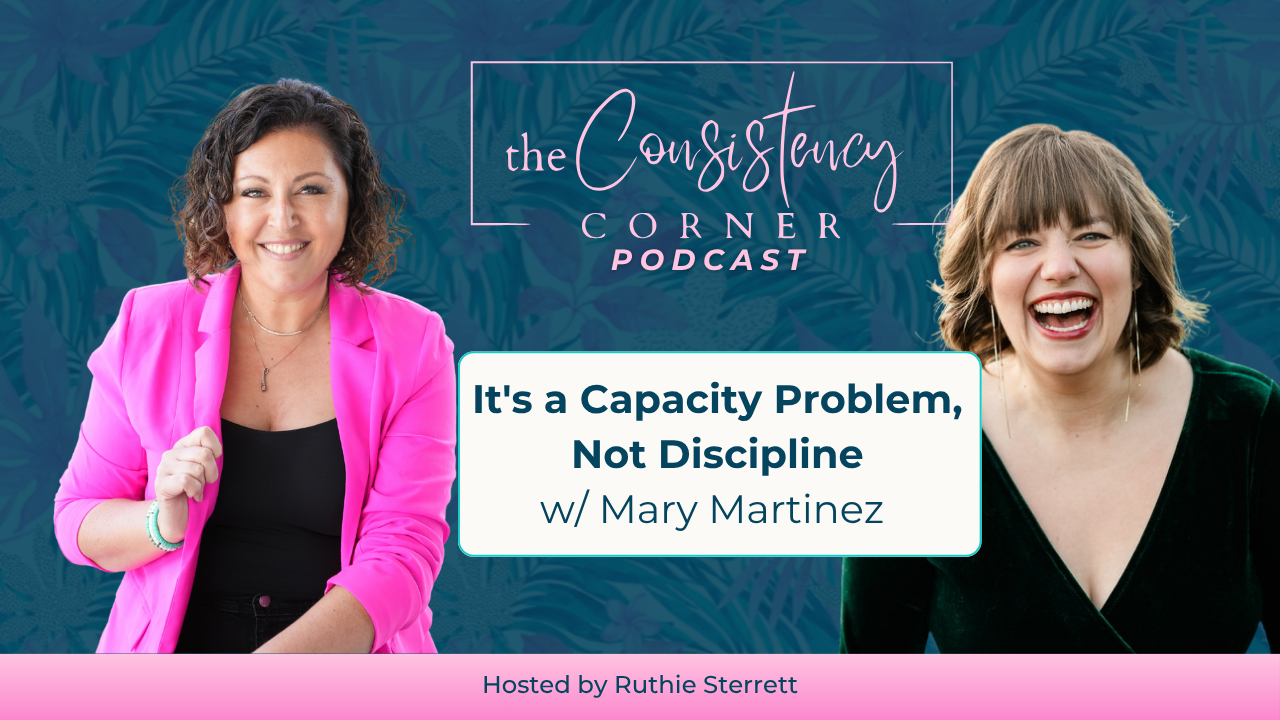
I had a conversation recently with Mary Martinez, founder of Mary Diana Designs, an interior design firm in Portland that builds sensory friendly spaces for neurodivergent families. Mary walked into our conversation convinced that consistency was her single biggest weakness. By the end, we figured out something different. She had already solved the thing she was beating herself up about. She just hadn't given herself credit for it.
Here is what you will learn from her story: how to figure out your real marketing capacity, why one platform cannot do every job in your funnel, and why things like referrals and networking count as marketing capacity too, even when they do not feel like content.
Why Does Marketing Feel Inconsistent Even When You're Trying Hard?
Marketing feels inconsistent when your capacity and your expectations do not match. It is rarely about effort or willpower.
Mary's business came after years as a biomedical engineer and a software engineer, and she brought that same analytical brain to design. She is also raising two young kids, ages two and five, and she told me she is busy from five in the morning until eleven at night with basically no breaks. That is her real capacity. Not the capacity of a full time content creator. Not the capacity of someone without small kids at home.
And here is the thing I want every founder listening to sit with. You are in an attention economy, competing for eyeballs with creators whose full time job is making content. If you run a service based business, your full time job is serving your clients, not producing content. Social media needs a different job description in your business than it has in a creator's business.
How Do You Figure Out Your Real Marketing Capacity?
You figure out your real capacity by naming the actual hours you have available for marketing in an average week or month, not the hours you wish you had.
When I asked Mary this directly, she said two to four hours every one to two weeks. That is the honest number. Not the number she felt like she should have. Not the number an Instagram guru would tell her she needs. The actual number, given her life right now.
Once you have that number, you can ask a much more useful question than "should I post more." You can ask, what is the highest leverage thing I can do with the hours I actually have.
For Mary, that meant getting real about the parts of content creation that do not show up in anyone's capacity math. Remembering to set up the tripod. Thinking through the angles. Taping her phone to a pole because there was no other way to attach it. That is real capacity being spent, even though it is invisible on any content calendar. I call this the mental load of marketing, and it works exactly like the mental load of parenting. It is the invisible tracking and planning that happens before you ever open your phone to shoot a clip, and it is real work even though nobody can see it.
Which Social Media Platform Should You Actually Focus On?
You should pick one platform to go all in on, not split your attention evenly across several.
Mary has used both LinkedIn and Instagram. She has a large LinkedIn network from twenty years in engineering, much of it local, and an Instagram account she has had for eight years that started as personal and slowly became more business focused. She was straddling both, unsure which one deserved her limited hours.
My advice to her was simple. Pick one and go all in. If that is Instagram, post there once a week and share the same post to LinkedIn as is, no extra editing, just enough to keep a presence. If she chose LinkedIn instead, the same logic applies in reverse. One platform gets the real effort. The other gets a repost to stay visible.
This only works if you are honest about what job you are asking that platform to do. In our Cornerstone Strategy process with clients, we map out three buckets: top of funnel, where people first discover you, middle of funnel, where they get to know you, and bottom of funnel, where they decide to reach out. One piece of content can usually do two of those jobs. It can never do all three. If you are asking one platform and one content plan to cover discovery, connection, and conversion, you are asking more of it than it can give you with the hours you actually have.
For Mary specifically, that meant recognizing Instagram was probably not the right tool for discovery on its own. Discovery on Instagram takes high volume and high consistency, which was never going to fit into two to four hours every couple of weeks. Instead, Instagram could serve as the middle of funnel platform, the place where someone who already heard about her from a friend goes to get to know her work before reaching out. That is a very different job than trying to get strangers to find her cold, and it changes what kind of content actually needs to get made.
The Mental Load of Marketing Nobody Talks About
The mental load of marketing is the invisible planning, remembering, and tracking that happens around content creation, and it deserves credit even though it is impossible to measure.
Mary told me she has watched influencers and longtime content creators make it all look effortless, while she is standing in her living room trying to figure out where her kids moved the tripod. That gap between what looks effortless online and what actually goes into a single reel is one of the most common things founders get wrong about their own capacity. You are not behind because someone else's process looks smoother. You are carrying weight they may not be carrying, or weight they have simply learned to hide well.
Why Referrals and Networking Count as Marketing Too
Referrals, word of mouth, and networking events are marketing capacity, not a shortcut around marketing.
Almost all of Mary's current clients come from word of mouth. A friend of a friend, or someone mentioning they need design help and hearing "I know a person." She wanted a more consistent version of that instead of leaving it to chance.
Here is the reframe I offered her. Going to a networking event is marketing capacity. So is preparing for it, taking notes on who you met, and following up afterward. That entire loop fits inside the same two to four hours a week she has for marketing, and it often builds a more durable pipeline than another hour spent filming and editing a reel. It is a slower build, but for a lot of service based founders, it is a more reliable one.
Should You Consider Paid Ads?
Paid ads are worth considering when you want to shorten the time a marketing strategy takes to work, not because they are required for every business.
Every marketing strategy takes time or money, usually both. If you have some budget available and limited time, ads can help new people discover you without asking for more of your hours. I told Mary this was worth exploring for her business specifically, alongside networking events, so she is not relying on social media alone to fill her top of funnel.
I want to be clear that ads are not a magic bullet, and they are not the right fit for every founder or every offer. But they are a real lever, sitting right alongside content and referrals, and a lot of founders skip past considering them because they assume ads are only for bigger businesses or different industries. Whether they make sense for you depends on your numbers and your goals, which is exactly the kind of thing worth mapping out before you spend a dollar on them.
What This Means for Your Own Marketing Capacity
If you are reading this and recognizing yourself in Mary's story, start with her same first step. Get honest about the real hours you have for marketing this season of your life, not the hours you think you should have. Then decide which one platform gets your real effort, and let referrals, networking, or even ads carry some of the weight instead of asking content to do it all.
You do not have a discipline problem. You have a capacity problem, and once you plan around your actual capacity instead of an imaginary one, consistency stops feeling like something you are failing at.
If you want to talk through your own capacity and channel priorities in person, join us at our next quarterly Marketing Mixer, a networking event built for mom founders having these exact conversations. Details are at MARKETING MIXER LINK.
If you want to connect with Mary directly, her design firm is at maridianadesigns.com, and you can find her on Instagram at https://www.instagram.com/marydianadesigns?utm_source=qr