How Women Founders Can Use Podcast Guesting to Build Visibility and Authority
You've probably thought about getting on more podcasts. Maybe you've even started a list of shows you'd love to be featured on. But if podcast guesting strategy has been sitting on your to-do list without much forward motion, there's a good chance the issue isn't effort. It's alignment.
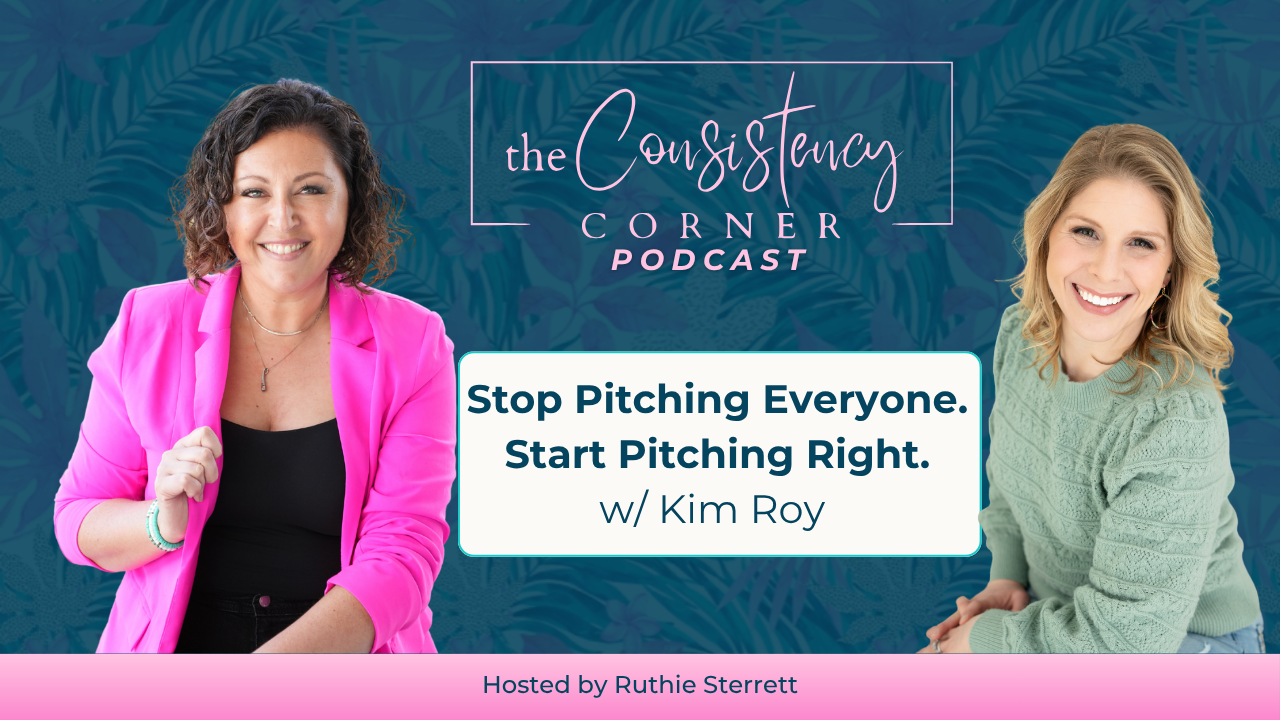
I had the best conversation recently with Kim Roy, founder of Pitch with Kim, and what came out of it was one of those episodes I keep thinking about days later. Kim helps women founders, coaches, and creatives get visible through strategic podcast guesting, and the way she talks about pitching completely reframes what most people think the process is about.
Here's what I want you to take away from this post: getting on podcasts is a visibility strategy, but only if you know who you're trying to reach, what you're saying to them, and why it matters. Without that foundation, you're just sending emails into the void.
What Does Podcast Guesting Strategy Actually Mean for a Women Founder?
Podcast guesting strategy means intentionally choosing which shows to pitch, what to say when you get there, and how to make sure the audience you're speaking to is actually your audience. It's not about getting on the biggest shows with the biggest numbers. It's about getting in the right rooms.
Kim put it plainly: one of the biggest goals she hears from clients is wanting to get on the most podcasts possible, the ones with the biggest reach. But reach doesn't mean much if the people listening aren't your ideal clients. The whole point of podcast guesting as a marketing strategy for founders is alignment between your message and the audience receiving it.
This is something I talk about with our clients constantly. If you try to talk to everybody, nobody listens. When you talk to one specific person, other people eavesdrop. That's how visibility compounds over time. You're not trying to go viral. You're trying to get in front of the right people, consistently, in conversations that feel natural.
Kim's done-for-you pitching agency operates from this exact premise. They don't blast generic pitches to hundreds of shows. They build personalized outreach that matches each client's voice, message, and goals to the specific audience of each podcast. And when they added AI into that process, they didn't use it to increase volume for volume's sake. They used it to increase precision, and the result was a higher success rate.
Why Is Messaging Alignment the Foundation of Any Visibility Strategy?
Messaging alignment means what you're saying, who you're saying it to, and where you're saying it all point in the same direction. Without it, even the best visibility strategy falls flat.
This showed up in a really honest way in my conversation with Kim. She spent about 15 months running a coaching program alongside her done-for-you pitching agency. Both offers had real value. Both served real people. But they served two completely different women, and marketing to both at the same time quietly drained her. The messaging required to attract a coaching client is different from the messaging that attracts a done-for-you client. The funnel is different. The language is different. The problems each woman is trying to solve are different.
I had a similar parallel from my own background. I used to work for a successful running retailer, and at one point they launched a cycling brand. The amount of effort it took to sell one bike was enormous because the audience wasn't there yet. The existing customer base was runners. Building a new audience from scratch while trying to maintain the core business is a real opportunity cost, and as a founder, you have to ask yourself what you're trading when you try to do both.
Kim made the hard call to pause the coaching program earlier this year to fully focus on scaling the agency. It wasn't a failure. It was clarity. And she said something that stuck with me: as soon as she made the decision, she could see the next step clearly for the first time in months. That's what happens when your message finally has one job.
If you've been feeling scattered in your content and marketing strategy, that scattered feeling is often a signal that your messaging is trying to serve too many audiences at once.
How Do You Know Which Podcasts Are Worth Pitching?
The right podcast to pitch is one where your ideal client is already listening, and where your topic maps directly to what that audience needs from you right now.
This sounds simple, but it trips a lot of founders up. Kim talked about the psychological factors that go into understanding your ideal client, beyond just demographics. It's not just knowing that she's a woman in her late 30s who runs a service-based business. It's knowing what she values, what she's afraid of, what she's tried before that didn't work. One of Kim's clients who had been in business for 20 years knew her ideal client so well she could tell you where she shops and why that matters. Because someone who shops at Costco and someone who shops at a boutique specialty store are making decisions based on entirely different values. That detail shapes everything about how you position your message.
When you know your ideal client that well, choosing the right podcast becomes a lot clearer. You're not looking for the biggest show. You're looking for the show where that specific woman is already tuning in. And when you get there, your pitch, your topic, and your talking points are already built around what she needs to hear.
This is also where AI is changing the pitching process, in a useful way. Kim shared that her team builds out individual AI projects for each client, loading in their voice, their goals, their messaging, and their brand. The output isn't generic. It's personalized pitches built around the specific shows they're targeting. The human element is still there because someone with judgment and context is guiding the process. But the efficiency goes up significantly, which means more pitches, more responses, and more opportunities.
For founders who are skeptical of AI in their marketing, Kim's approach is worth paying attention to. She's not saying everyone needs to use it the same way. She said she's meeting clients where they are. If you want the AI-powered system, she can build that. If you want a more traditional done-for-you approach, that's available too. What matters is that the pitching is personalized, consistent, and strategically aligned with your business goals.
What Gets in the Way of Showing Up Visibly as a Founder?
The biggest barrier to visibility for most founders isn't a lack of strategy. It's the stories they're telling themselves about whether they're ready.
Kim was direct about this. She talked about women being their own bottleneck to visibility, not because they lack capability, but because fear and perfectionism keep them waiting for the right moment. Waiting until the offer suite is perfect. Waiting until the messaging is nailed. Waiting until everything is in place before they pitch, before they post, before they show up.
The thing is, your messaging is going to evolve anyway. It always does. Waiting for it to be perfect before you do anything means you're standing still while your business needs you to move. Kim's advice is to start where you are. If you've never shown up consistently on social media, start there. It doesn't have to be polished. It doesn't have to be perfectly on-brand. Just start showing up so that showing up becomes a habit.
She also said something I think about a lot: visibility starts with yourself. Before you can show up publicly in your business, you have to be willing to see yourself clearly, with grace, not just with a critical eye. That pattern of chasing the next level while beating yourself up for not being there yet is one of the things that quietly keeps founders invisible. The fear itself becomes the reason to wait.
This connects directly to sustainable marketing as a founder. Visibility isn't a sprint. It's a practice. And the founders who build real authority over time are the ones who commit to showing up consistently, even imperfectly, rather than waiting for the version of themselves that feels ready.
Pitching Is Just a Conversation
One of my favorite things Kim said in this episode is that pitching is just a conversation. We pitch every day. You pitch your kid on eating vegetables. You pitch your partner on where to go for dinner. You pitch a prospective client in a DM before you ever get on a call. Pitching is the human act of sharing an idea with someone you have a relationship with, or want to have a relationship with.
When you reframe it that way, the resistance softens a little. A podcast pitch isn't a cold transaction. It's an invitation to a conversation. And if you've done the work of knowing who you serve, what you help them with, and why it matters, the pitch is just you articulating that clearly to the right person at the right time.
The skill that makes pitching work, Kim said, is the ability to truly listen. Not just listen waiting to talk, but listen to understand. Listen for what's underneath what someone is saying. What do they need that they haven't quite named yet? That skill, applied to podcast hosts you want to work with, applied to your ideal clients, applied to your own business decisions, is what separates the founders who build real authority from the ones who stay stuck.
If you're a founder who wants to get more visible and wants support building a pitching strategy that actually fits your business, connect with Kim at @pitchwithkim on Instagram or grab her free visibility guide at {INSERT LINK}.
Ready to Simplify Your Marketing Strategy?
If this episode resonated, it's probably because you're at a point in your business where you know you need a clearer strategy, not more content, not more platforms, just a smarter approach to showing up. That's exactly what we help with at The Consistency Corner.
And if you're ready to take a deeper look at your marketing strategy with support, learn more about working with The Consistency Corner.
Our Marketing Mixer is a free quarterly event where founders like you have real conversations about what's working, what's not, and how to move forward without burning out. Register for the next one.